
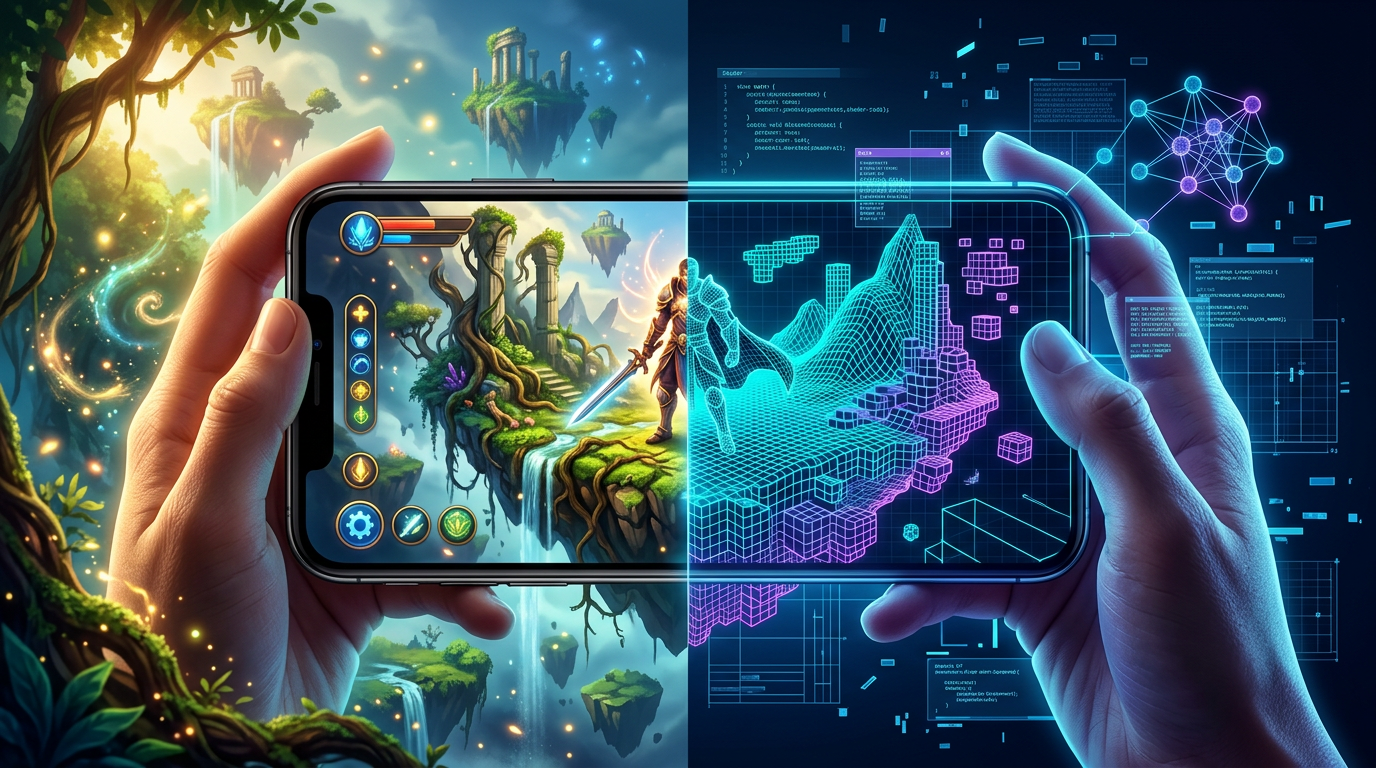
Mobile gaming is no longer the scrappy little sibling of console and PC gaming. It is the undisputed heavyweight of the entertainment industry. Generating more revenue than consoles and PCs combined, the mobile market puts a high-powered gaming rig into the pockets of billions of people worldwide.
Yet, beneath the surface of this booming industry lies a growing tension. Player expectations have skyrocketed. Today’s everyday mobile gamers expect console-quality visuals, seamless 60fps performance, and constant live-service updates. For AAA publishers with hundred-million-dollar budgets, meeting these demands is an expensive arms race. For indie game developers and small studios, it has increasingly felt like an impossible barrier to entry.
Enter artificial intelligence.
When most people talk about the future of mobile games with AI, their minds jump straight to what happens on the screen: hyper-intelligent NPCs that hold unscripted conversations, or endless procedurally generated worlds. While those player-facing features are exciting, they are only the tip of the iceberg.
The true revolution, the one actively reshaping the industry right now, is happening behind the curtain. AI in mobile game development is fundamentally rewriting how games are drawn, coded, and tested. By collapsing production timelines and slashing overhead, behind-the-scenes AI is giving indie developers studio-level firepower while promising everyday gamers richer, more inventive, and far less buggy experiences.
Let’s pull back the curtain on the three core pillars of game development being transformed by AI, and what this shift means for the future of the games on your phone.
1. Reimagining the Art Pipeline: From Concept to Final Asset
In traditional mobile game development, the art pipeline is almost always the biggest bottleneck. A single stylized mobile RPG can require thousands of unique assets: character sprites, environment tiles, UI icons, lighting maps, and multi-layered animations. For a three-person indie studio, creating this volume of art from scratch can easily stretch a development cycle from six months to two years.
Generative AI and machine learning tools are dismantling this bottleneck, not by replacing human artists, but by supercharging the most time-consuming phases of production.
Rapid Ideation and Concepting
Before a single 3D model is sculpted, developers spend weeks establishing a game’s visual identity. Today, art directors use generative AI to produce dozens of mood boards, color palettes, and architectural concepts in an afternoon. Instead of spending 40 hours sketching five different biomes only to scrap four of them, a team can iterate visually in real time, locking in a cohesive art direction in a fraction of the time.
Automated Asset Generation and Texturing
The heavy lifting of asset creation is also getting an AI upgrade. Modern AI game art tools can now:
- Generate seamless PBR (Physically Based Rendering) textures from simple text prompts or reference photos, complete with normal, roughness, and ambient occlusion maps.
- Convert 2D concept art into base 3D meshes, giving 3D modelers a 70%-complete foundation to refine rather than starting from a blank cube.
- Automate rigging and weight painting, allowing characters to be animated in minutes instead of days.
Industry Takeaway: For indie mobile game development, this doesn’t mean firing artists. It means elevating them. A solo developer or small art team can now shift from being “asset grinders” to true creative directors, focusing their human energy on signature hero characters, iconic UI design, and visual polish that makes a game memorable.
2. Smarter Coding and Rapid Prototyping
If art is the body of a mobile game, code is its nervous system. Developing for mobile presents unique engineering hurdles that PC and console devs rarely have to worry about. Mobile games must run smoothly on limited RAM, avoid draining a user’s battery in twenty minutes, and prevent smartphones from turning into pocket-sized hand warmers due to thermal throttling.
AI coding for games is turning these complex engineering challenges into manageable workflows, fundamentally changing how developers build and iterate.
Eliminating Boilerplate and Accelerating Prototyping
Game development involves a mountain of repetitive “boilerplate” code: inventory systems, save/load states, leaderboards, and basic physics controllers. AI coding copilots integrated directly into engines like Unity, Unreal Engine, and Godot now handle this foundational heavy lifting with startling accuracy.
More importantly, this speed unlocks rapid prototyping. In game design, the secret to a hit game is rarely the first idea; it’s the tenth iteration of that idea. When AI helps a programmer spin up a playable prototype of a new combat mechanic or puzzle loop in two hours instead of two weeks, studios can afford to experiment. They can fail fast, test wild concepts, and double down on what actually feels fun to play.
Shaders, Porting, and Performance Optimization
Writing custom shaders (the code that controls how light, water, and shadows behave) is notoriously difficult, math-heavy work. AI assistants excel at translating plain-English visual goals (such as “Write a lightweight stylized water shader optimized for mid-range Android GPUs”) into functional code.
Furthermore, AI-assisted profiling tools are beginning to analyze game code to spot memory leaks, inefficient draw calls, and CPU spikes before the game ever reaches a player’s device. For tech enthusiasts and mobile gamers, this translates directly into smoother frame rates and longer play sessions on older or budget-friendly phones.
Traditional vs. AI-Assisted Mobile Game Dev
How the examples in this article compare for concept art, prototyping and QA testing.
Concept art
Prototyping
QA testing
Bar lengths are illustrative and scaled to the examples quoted in this article, not measured data.
3. The Unsung Hero: AI-Driven QA and Automated Playtesting
Ask any seasoned mobile game developer what keeps them up at night, and they won’t say “running out of ideas.” They will say device fragmentation.
Unlike console developers who build for two or three standardized pieces of hardware, mobile developers have to support an astronomical matrix of devices. Between iOS and Android, there are hundreds of different screen aspect ratios, refresh rates, GPU architectures, and operating system versions. Manually testing a 20-hour game across dozens of devices is slow, expensive, and prone to human error.
This is where automated game testing powered by AI is quietly becoming the industry’s biggest game-changer.
Bots That Play Like Humans (Only Faster)
Traditional automated testing relies on rigid scripts: if a button moves three pixels to the left, the test breaks. Modern AI QA agents use reinforcement learning and computer vision to actually see and play the game like a human tester.
A studio can deploy hundreds of AI agents overnight to play through a new build simultaneously. These bots don’t just follow the intended path; they are trained to be chaotic. They jump into corners, spam abilities simultaneously, disconnect and reconnect to Wi-Fi mid-match, and try to break level geometry. By morning, the development team has a heat map of every crash, soft-lock, and visual glitch, complete with video replays and exact reproduction steps.
Balancing Economies and Difficulty Curves
Beyond squashing bugs, AI playtesting is revolutionizing game balance. In competitive mobile games or complex strategy titles, a single overpowered unit or a slightly skewed in-game economy can ruin the player experience.
By simulating tens of thousands of matches using AI agents with different “playstyles” (aggressive, defensive, casual, min-maxing), developers can spot difficulty spikes and meta-breaking exploits before launch day. The result is a tighter, fairer game right out of the gate.
What This Means for Everyday Mobile Gamers
It’s easy to view behind-the-scenes AI as purely a “developer story,” but the ripple effects will be felt directly by anyone who downloads games from the App Store or Google Play.
- A Renaissance of Indie Creativity: When a two-person team can achieve the visual polish and technical stability that previously required a 20-person studio, the barrier to entry drops dramatically. Players can expect a wave of weird, bold, genre-bending indie mobile games that risk-averse mega-publishers would never greenlight.
- Fewer Launch-Day Disasters: With AI-driven QA catching device-specific crashes and performance bottlenecks early, the dreaded “day-one patch” culture of broken mobile launches should steadily improve.
- Faster, Richer Content Updates: Live-service mobile games live and die by their update cadence. AI-assisted pipelines allow studios to roll out new seasonal events, maps, and cosmetics faster, keeping communities engaged without burning out development teams.
The Reality Check: Navigating Ethics, Quality, and “AI Slop”
Any honest, authoritative look at the future of mobile games with AI has to address the elephant in the room: the backlash.
As generative AI tools have become widely accessible, app stores have seen an influx of low-effort, hastily assembled games filled with generic AI art, mismatched styles, and zero soul. Gamers have rightfully coined a term for this: “AI slop.”
Everyday gamers are remarkably perceptive. They can spot a soulless cash-grab within thirty seconds of launching an app, and they will punish it with one-star reviews. At the same time, the industry is actively navigating complex questions around copyright, training data ethics, and evolving disclosure policies from platforms like Apple, Google, and Steam.
The Golden Rule for the Next Decade
The studios that will dominate the next era of mobile gaming understand one fundamental truth: AI is a co-pilot, never a creative director.
AI cannot invent a deeply resonant story, design a tactile game feel that makes a player smile, or understand the subtle cultural nuances that turn a good game into a beloved community phenomenon. Technology can accelerate the how, but human developers must always own the why.
When AI is used to cut corners, players feel cheated. When AI is used to eliminate tedious busywork so human creators can pour more love into gameplay, narrative, and polish, everybody wins.
Conclusion: The Next Era of Mobile Gaming
We are standing at a pivotal inflection point in interactive entertainment. For the past decade, winning in mobile gaming was largely a battle of budgets: who could afford the biggest art teams, the largest QA farms, and the most aggressive user acquisition campaigns.
Behind-the-scenes AI is flipping that script. By democratizing art pipelines, accelerating code optimization, and automating the grueling reality of cross-device testing, AI is shifting the competitive advantage back to where it belongs: imagination, execution, and great game design.
Whether you are an indie developer dreaming of your first breakout hit, a tech enthusiast marveling at the pace of innovation, or an everyday gamer looking for your next obsession on your morning commute, the future of mobile gaming is looking faster, smarter, and more creative than ever before.
What’s your take? As a gamer or developer, which behind-the-scenes AI shift excites you the most, and where do you draw the line between “smart tool” and “too much AI”? Drop your thoughts in the comments below. I’d love to hear your perspective!